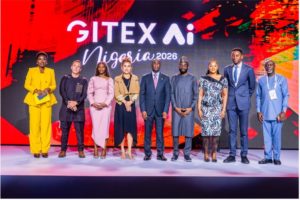
- Inuwa Outlines Nigeria’s Vision to Build Africa’s Digital Future
- Why Nigeria Continues to Attract Global Technology Investment- GITEX CEO
By Lukman Oladokun
Deputy Governor of Lagos State, Dr Kadir Obafemi Hamzat, has made a strong case for Lagos as Africa’s premier destination for technology investment, urging global investors, technology firms and innovators to establish long-term operations in the state and use it as a gateway into the continent’s rapidly expanding digital economy.
Speaking on behalf of Governor Babajide Sanwo-Olu at GITEX Nigeria 2026 held at the Landmark Event Centre, Lagos, Hamzat said the state’s emergence as the host of one of the world’s leading technology exhibitions reflects its growing economic influence, innovation ecosystem and strategic importance to Africa’s future economy.
According to him, the decision to host GITEX in Lagos was not based on goodwill or sentiment, but on the city’s economic strength and growing relevance within the global technology landscape.
“It was not a courtesy extended to us. It was a commercial judgement made about Lagos,” Hamzat said. “We did not earn this event because Lagos is easy. Lagos is not easy. We earned it because Lagos is consequential. What happens in this city sets the direction for this continent.”
The Deputy Governor said Lagos has evolved into one of Africa’s most influential economic hubs, with developments in the state increasingly shaping technology, innovation and investment trends across the continent. He noted that startups founded in Lagos have grown into cross-border businesses operating in sectors such as financial technology, logistics and e-commerce, reinforcing the state’s reputation as a leading innovation ecosystem.
Highlighting infrastructure as a key driver of growth, Hamzat said Lagos has deployed about 3,000 kilometres of fibre-optic infrastructure and is progressing towards a 6,000-kilometre unified fibre network to expand broadband access and strengthen the digital economy. He stated that the network was built under an open-access model that enables operators to share infrastructure, thereby reducing costs and accelerating connectivity projects.
“When a new entrant arrives in Lagos, the most expensive part of their network is already on the ground,” he said. “Lagos is not at the end of the world’s digital infrastructure. Lagos is one of its landing points.”
Addressing concerns around power supply, Hamzat said Lagos has opted for structural reforms, including its Electricity Law, the establishment of the Lagos State Electricity Regulatory Commission and the licensing of operators across generation, distribution and metering. He added that the state is pursuing increased electricity capacity and expanded access to reliable power for businesses and residents.
“Lagos has constraints, but what distinguishes Lagos is that we name those constraints, we regulate them, we finance them and we invite you to build the solution with us,” he said.
The Deputy Governor identified talent as Lagos’ greatest competitive advantage, noting that technology professionals from the state are contributing to organisations across major innovation centres around the world. He also highlighted state-backed support for research, innovation and entrepreneurship through various initiatives aimed at strengthening the startup ecosystem and commercialising research outputs.
On artificial intelligence, Hamzat said Africa must play an active role in creating technologies rather than merely consuming them.
“We must become builders. That means talent, compute capacity, data infrastructure, research institutions and commercial models that keep value on this continent instead of exporting it,” he said.
In a direct appeal to international technology companies, he urged investors to deepen their presence in Lagos by establishing engineering hubs, data centres, research facilities and regional headquarters in the state.
“Do not merely sell into Lagos. Put your engineering here. Put your data centre capacity here. Put your regional headquarters here,” Hamzat added.
He said Lagos remains committed to building an innovation-driven economy where technology serves as a catalyst for growth, inclusion and prosperity.
“The future will not be built by those who predict it. It will be built by those who have the courage to create. And here in Lagos, we are creating,” he said.
Also speaking, the Director-General of the National Information Technology Development Agency (NITDA), Kashifu Inuwa, said Nigeria is strategically positioning itself as Africa’s digital innovation hub through investments in artificial intelligence, digital skills, sovereign digital infrastructure and emerging technologies.
Addressing government officials, technology leaders, investors and development partners, Inuwa said the global economy is undergoing a profound transformation in which intelligence, creativity and innovation are becoming the primary drivers of prosperity.
“Artificial Intelligence is making intelligence abundant and accessible. Countries that can effectively harness human creativity, innovation and digital capabilities will define the future global economy,” he said.
According to the NITDA Director-General, Nigeria’s digital transformation agenda aligns with the Federal Government’s economic diversification and growth strategy, with technology serving as a critical enabler of productivity, competitiveness and inclusive development
He said government is pursuing a comprehensive approach that combines talent development, innovation support, policy reform and strategic infrastructure investments to position Nigeria as a leading digital economy on the continent. This includes efforts to integrate digital literacy and emerging technology skills into the education system and expand initiatives such as the 3 Million Technical Talent programme.
Inuwa also highlighted the importance of advancing frontier technologies such as artificial intelligence, blockchain, robotics, additive manufacturing and the Internet of Things to improve productivity across agriculture, healthcare, education, manufacturing and public service delivery.
On digital sovereignty, he said Nigeria is implementing policies around data sovereignty, cloud sovereignty, operational sovereignty and AI sovereignty to ensure the country actively develops and owns digital solutions.
“We do not want to be at the receiving end of technology alone. We want to be active builders, creators and owners of technology that solves real problems and creates value for our people,” Inuwa said.
He further highlighted initiatives aimed at strengthening the innovation ecosystem, including implementation of the Startup Act, e-invoicing systems, public key infrastructure, software quality assurance standards and reforms to technology procurement processes. These measures, he said, are intended to create an enabling environment for startups and technology companies to scale and compete globally.
The NITDA boss also pointed out that investments in digital public infrastructure, broadband expansion and increased computing capacity as essential foundations for a thriving digital economy
Calling for deeper collaboration, he invited global technology companies, investors and ecosystem partners to work with Nigeria in developing solutions for Africa and international markets.
“Nigeria is open for innovation, open for partnership and open for investment. We invite the world to come and build with us as we shape the future of digital transformation in Africa,” he said.
He noted that GITEX Nigeria 2026 provides an important platform for attracting investment, strengthening partnerships and showcasing Nigeria’s growing influence in the global digital economy. With the right combination of talent, innovation, policy support and infrastructure, he maintained that Nigeria is well-positioned to emerge as Africa’s leading digital innovation hub.
Earlier, Chief Executive Officer of GITEX, Trixie LohMirmand, said the decision to bring the global technology exhibition to Nigeria was based on clear evidence that the country is emerging as one of the world’s most dynamic centres for innovation, entrepreneurship and technology investment.
LohMirmand said the country’s progress since the inaugural event had been significant. She said, “A year ago when we stood here, all the conversations were about the potential of Nigeria and Lagos. Today, Lagos is the highest-rated startup ecosystem and ranks number one in Africa for AI activity and funding,” she said.
She noted that Nigeria’s artificial intelligence strategy had advanced from policy development to implementation, helping to strengthen the country’s attractiveness to investors seeking talent, innovation and growth opportunities.
However, she said the next challenge is to translate that momentum into globally competitive businesses, exports and jobs.
“The challenge now is about turning those advantages into globally competitive businesses, exports, jobs and knowledge. Talent needs access to markets. Startups need access to customers. Innovation needs capital, and capital needs confidence,” LohMirmand said.
She explained that GITEX serves as a bridge connecting Nigerian innovators and entrepreneurs with international investors, technology leaders and new markets.
“Nigeria has one of the biggest assets in the world: its young people,” she said, stressing that technology events must move beyond showcasing startups to helping them build sustainable and globally competitive enterprises.
“It is not enough to consume AI. When you create AI, you become a superpower,” she added.
Describing the exhibition as more than a technology showcase, LohMirmand said GITEX functions as an economic platform that accelerates growth across the innovation ecosystem.
“Gitex is not an exhibition. It is an economic infrastructure that supports the technology ecosystem,” she said.
She added that the event compresses years of networking, partnership building and business development into a few days by bringing together investors, multinational technology companies, policymakers and innovators from across the world.
LohMirmand concluded that the success of GITEX Nigeria demonstrates that the country is no longer simply a market to watch but an increasingly important player in the global innovation economy.
“For us, the mission is clear. We are bringing the world into Nigeria and creating the connections that help Nigerian innovation reach the rest of the world,” she said.