By Wole Alao
At the Tech Revolution Africa 2026 conference, Kashifu Inuwa CCIE, Director General of NITDA, unveiled a bold roadmap for Nigeria’s digital sovereignty, positioning the nation as a global powerhouse. Addressing a room of Africa’s top innovators at the Landmark Event Centre, Inuwa detailed a future anchored by aggressive infrastructure development and a world-class workforce designed to bridge the gap between local talent and global demand.
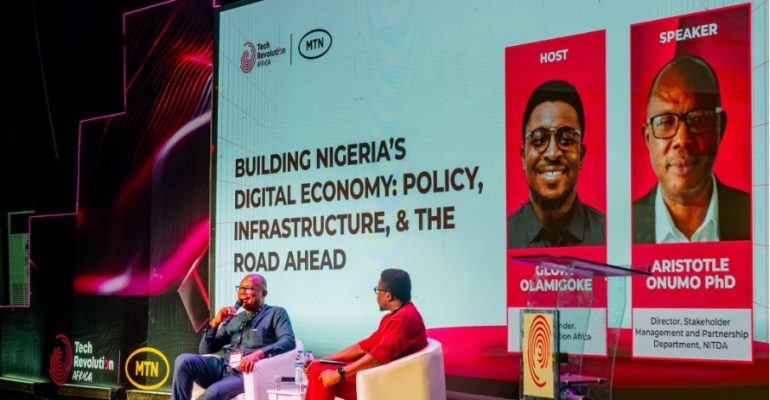
Represented by the Director of Stakeholder Management and Partnerships, Dr Aristotle Onumo, the NITDA DG delivered a fireside chat titled “Building Nigeria’s Digital Journey: Policy, Infrastructure, and the Road Ahead.” He outlined NITDA’s strategic approach to digital transformation, anchored on enabling policies, resilient infrastructure, and people-driven innovation.
Emphasising the importance of the digital economy to national development, Inuwa noted that “the digital economy is fundamental for job creation, global competitiveness, and economic growth,” adding that Nigeria is on the right trajectory despite existing infrastructure gaps. According to him, progress over the past few years has been driven largely by policies designed to catalyse innovation rather than stifle it.
On data sovereignty, he disclosed that NITDA is collaborating with global hyperscalers to ensure Nigeria’s data remains hosted locally.
“Talent can be anywhere in the world, but data infrastructure must be built here,” he said. While explaining that localising data centres is critical to Nigeria’s data economy and digital sovereignty. He added that the Nigeria Data Protection Act has provided a strong legal foundation for safeguarding personal data and strengthening trust in the digital ecosystem.
Addressing talent development, Inuwa reaffirmed NITDA’s ambitious digital literacy targets, stating that “our vision is to ensure that 50 million Nigerians are digitally skilled by 2027.”
He explained that this goal is being pursued through partnerships with the National Youth Service Corps (NYSC), educational institutions, universities, the civil service, and private sector partners to drive nationwide digital literacy and skills acquisition.
He also highlighted the 3 Million Technical Talent (3MTT) programme, describing it as a transformative initiative for building globally competitive professionals.
Stressing that exporting skills should not be seen as a loss, he said, “Digital talent is global talent, and when our talents go global, the economy benefits through remittances, experience, and reputation.”
Inuwa further pointed to the Nigerian Startup Act as a major policy milestone that is reshaping the innovation landscape by providing incentives, recognition, and structured support for startups. He reiterated that strong public-private collaboration remains central to NITDA’s strategy, noting that “regulation is not meant to stifle innovation, but to amplify it and create new markets.”
With an optimistic outlook and expressing confidence that Nigeria’s digital economy will soon become a global reference point, he concluded that, “In the next few years, Nigeria’s digital economy will be an engine for growth, and it will be robust, scalable, and globally competitive.”