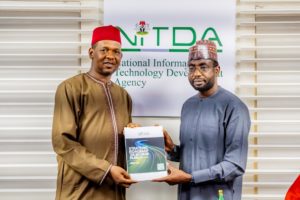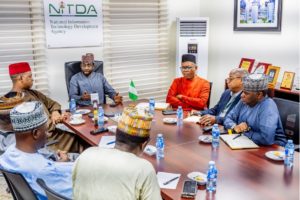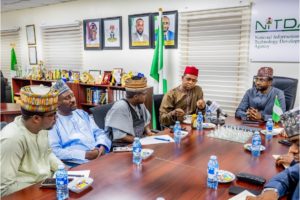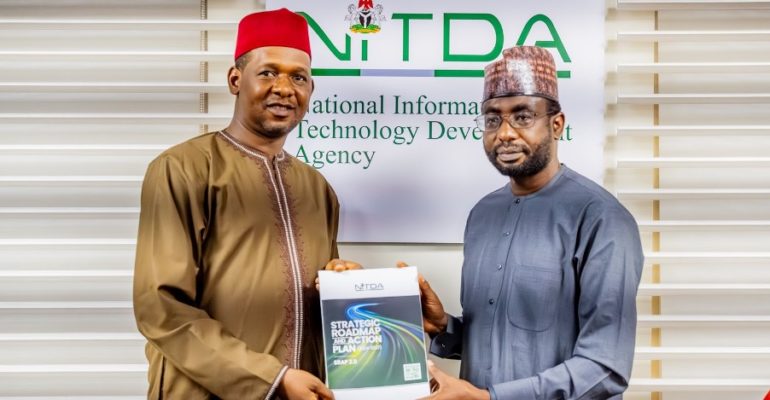
The Commissioner for Science, Technology and Innovation in Kano State, Honourable Yusuf K/Mata, led a delegation on a courtesy visit to the Director General of the National Information Technology Development Agency (NITDA), Kashifu Inuwa Abdullahi, CCIE. The visit was centred on strengthening collaboration and building strategic partnerships to support Kano’s ambitious drive toward becoming a hub for digital literacy, innovation, and inclusive technological growth.
Welcoming the delegation, the Director General commended the initiatives already underway in Kano and expressed NITDA’s full readiness to partner with the state. “For us, digital literacy is a top priority,” he said. “You cannot achieve a digital economy without a digitally fluent population.” He emphasized that digital skills are not just about employability but about opening new economic pathways and solving everyday problems. “If you train someone, they can either get a job, use their skills to expand their market reach, or apply that knowledge to solve real-life challenges. And in Nigeria and Africa, we have many challenges that need innovative ideas to solve.”
Inuwa highlighted the importance of ensuring that training leads to action. “After learning, what’s next? We need to build a system where people can create digital solutions, become part of the global gig economy, and solve problems around them,” he said. Referring to the growing number of Nigerians earning in foreign currency by working remotely, he noted, “We have people earning up to $5,000 a month from Nigeria. With a young and vibrant population, especially in a state like Kano, we can achieve so much more. Human capital development has more value than any natural resource.”
The DG assured the Kano delegation of NITDA’s support, pledging collaboration on content development, strategic guidance, and access to the agency’s national network. “It’s a win-win. Our goals are aligned, and we will work with you 100 percent to realize this shared ambition of building a digitally empowered society.”
He also proposed deeper collaboration in research and innovation, particularly in applying artificial intelligence to agriculture, education, and healthcare. He pointed out how simple digital tools, like weather forecasts or land fertility insights, could dramatically boost agricultural productivity and reduce risk for smallholder farmers. “These are the things that touch the grassroots. We must use technology as a tool to improve everyday lives. Since agriculture is a major part of Kano’s economy, we can jointly develop tech-based solutions that increase yield and reduce losses,” he said.
Responding to the DG’s remarks, Honourable K/Mata thanked NITDA for its support and shared details of Kano’s reform agenda. He explained that the ministry’s current efforts are rooted in a co-creation model that brings together government, the private sector, the media, and ecosystem actors to work collectively on designing solutions. “We are working together to reclaim our past glory in science and technology,” he said. “Kano has a rich history. As far back as the 1970s, we were already leading in the field of science and technical education. Our mission now is to build on that legacy with a forward-looking vision.”
One of the Commissioner’s key initiatives is the development of a robust talent pipeline. He explained that the ministry is adopting both forward and backward integration. “We are looking at market demand both local and international and designing that against our talent supply,” he said. “On the supply side, we are building skills from the ground up.” He revealed that, with the approval of Governor Abba Kabir Yusuf, Kano has begun converting 44 secondary schools into ICT-based technical and vocational education institutions. In addition, one special technical school is being transformed into an ultra-modern ICT school. The ministry has also partnered with the Science and Technical Board to establish ICT departments in all special science and technical schools.
“We are doing this to prepare our youth for the digital economy and to make sure that the infrastructure we are investing in is matched by human capital. Without digital skills, infrastructure alone won’t make a difference. If people are not digitally literate, then you’re just kicking a dead horse,” he added. He also shared plans for a mass digital literacy program targeted at rural and underserved communities in the state.
Honourable K/Mata emphasized that policy and institutional reform is also central to Kano’s strategy. Following a benchmarking visit to Lagos, the ministry is now working on the establishment of three major bodies like the Kano Science, Research and Innovation Council (KASRIC), the Kano Resident Information Management Agency (KANDRIMA), and Innovate Kano, a new platform designed to consolidate innovation activities across the state. “We are creating the structures that will ensure our vision is not only implemented but sustained,” he said.
Both the DG and the Commissioner closed the meeting by expressing strong interest in deepening cooperation between their institutions. With Kano’s population strength, historical relevance, and rising momentum in the innovation space, and NITDA’s technical expertise, strategic networks, and national mandate, the partnership stands poised to become a model for digital transformation efforts across Nigeria.